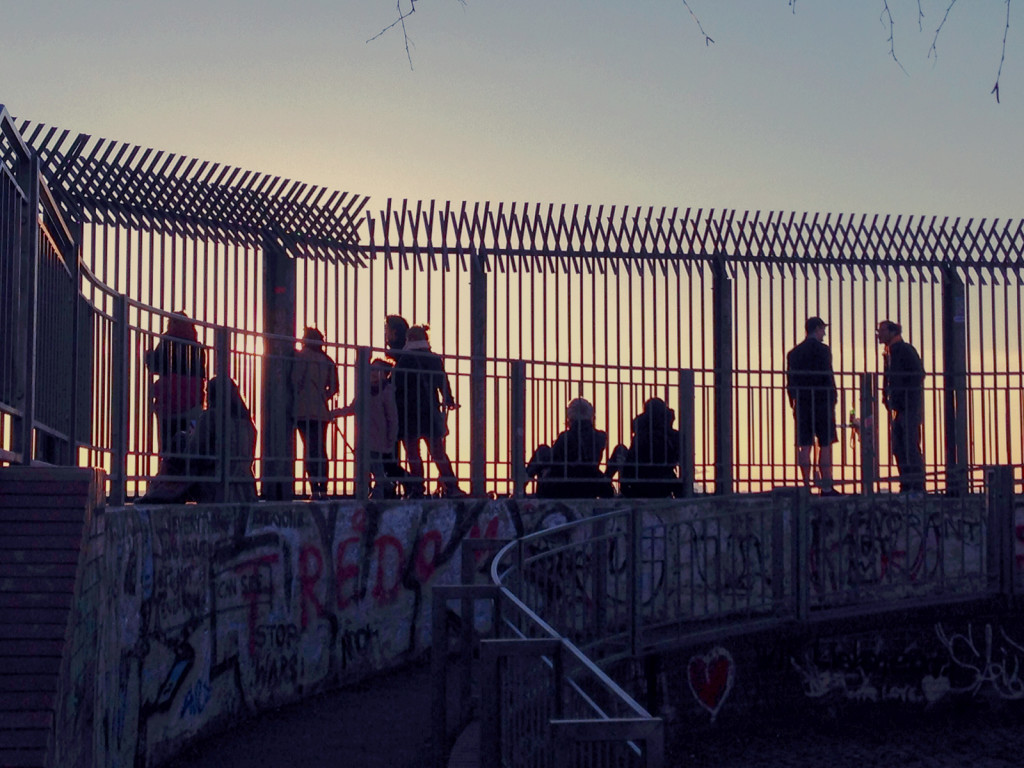
Photo by Linka A Odom
[EDIT: this competition is now closed. Click here to see if we’re running any open competitions]
Letters from Berlin is a collection of 12 weekly essays, each focussed on a different district of the city. Bringing together photographers, filmmakers, writers, translators and theatre directors, Letters from Berlin (published by The Pigeonhole) reflects the many creative facets of this uncanny city, creating an album of vivid snapshots.
Enjoy an excerpt from one of our favourite essays, Marcel Krüger’s walk through Wedding, and enter our competition to win a free subscription to the series.
Links, links, links, links,
Ein Lump wer kapituliert.
Links, links, links, link!
Der rote Wedding marschiert!
– Erich Weinert, 1929
Wedding was a raw expanse of towerblocks, tattoo pits, kebab shops. Nogoodniks in mauve-coloured tracksuits decorated every corner. We had a properly respectful air as we passed through. This was how Berlin was supposed to be. […] The rearsides of the towerblocks loomed either side of a dirt pathway itchy with catkins beneath our sandals, and the word ‘proletariat’ rolled its glamorous syllables over my tongue.
– Kevin Barry, from ‘Berlin Arkonaplatz – My Lesbian Summer’, 2012
…Sometimes I think that while Berlin is the ever-changing Moloch on the plains of Brandenburg and the wetlands of the Spree, its outgrowth Wedding has remained endearingly static over the last fifty years. Maybe it always had a certain roguishness that prevented beautification and change. Wedding is allegedly always up-and-coming. ‘Der Wedding kommt’, Wedding is coming, some of my friends used to say when I visited Berlin for the first time in 2001, staying near the fleshpots of then ungentrified Prenzlauer Berg. Some keep repeating it to this day. Der Wedding kommt.
It’s Sunday, by now after lunchtime and I’ve walked a bit: it’s definitely time for refreshments. I take a detour from Seestraße and step into a neighbourhood brewery, Vagabund Brauerei on Antwerpener Straße. Three American home brewers opened a small taproom here in 2013, and they serve their own craft brews together with classic German and Belgian beers.
Like many other working-class areas, Wedding has a long tradition of brewing, which is slowly being rejuvenated. On nearby Müllerstraße is Eschenbräu, one of Berlin’s first craft breweries, open since 2001, and also close by is the best small beer speciality store in Berlin, Hopfen & Malz. There’s also the VLB Berlin (Versuch- u. Lehranstalt für Brauerei in Berlin), which provides research, training, education and service for the brewing industry. Founded in 1883, it moved to its current location on Seestraße in 1898, and until 1981 it even operated the Hochschul Brauerei, or brewery university, where students could try brewing different types of beer, which were then sold to the public.
Vagabund Brewery has become a poster child for the local craft beer scene. It has been featured in articles in The New Yorker, Forbes travel, Der Spiegel and a plethora of German newspapers feting the craft-beer trend. One could easily say that Vagabund is a pub catering only to moustachioed expat drinkers and not to locals and is therefore a prime example of gentrification pushing out existing social structures, a topic hotly discussed in Berlin. As I enter the bright interior of the taproom, almost deserted so early on a Sunday afternoon, I’m glad to see both Matt Walthall and David Spengler, two of the three owners, manning the bar. We soon start chatting about beer and gentrification.
‘So often people ask us about this “trend” of locally brewed craft beer,’ Matt says. ‘David and I studied history, and that is part of what draws us to brewing: there’s so much history involved. In the eighteenth and nineteenth centuries, every Berlin neighbourhood had its own brewery – so, for us, the whole appeal is not about being trendsetters. We clearly see ourselves as part of a tradition.
‘We didn’t plan to come to Wedding specifically. We looked all over Berlin for a year and a half, but we couldn’t find the right combination of brew room, taproom and a big enough basement. I was actually the one who was the most sceptical of Wedding – I thought of Bernauer Straße, Plattenbauten and so on. And then I moved here and now I’m the biggest promoter. Wedding still has a strong community feel to it, and there are no areas here where whole blocks have been bought by developers, like in Neukölln. And it’s one of the few places in Berlin where the classic population structures have not been pushed out – the majority of our neighbours have been here for twenty or thirty years.’
Indeed, the neighbouring commercial establishments are a strange mix of shisha bars, corner pubs with Sternenburger posters (‘Sterni’ is the cheap and mass-produced Berlin beer preferred by many inhabitants of Wedding) and bookmakers with bright neon signs reflecting off the street’s wet cobblestones. Three years ago, a man ran amok on the street here, armed with two knives and an axe, and was shot by the police. But in general nowadays, things are fairly quiet.
‘We love how laid back the street is,’ David chips in. ‘Sometimes when I’m in some of those “happening” districts down in the southeast of the city, I’m amazed because there’s just so many people. In our little promenade street, it’s much more laid-back and chill. I also like knowing the people from the neighbourhood and even having a drink with them sometimes. I think that might be harder to do somewhere else.’
‘In the beginning I was quite nervous about whether the neighbours would accept us,’ Matt admits. ‘There was this elderly woman walking past the shop every day when we were renovating, and she was always giving us this look, and I thought, “She probably hates us.” Then one day when I was outside cleaning the windows she came up to me and said, “Oh I’m so glad that you kids are here now!” Afterwards we learned that the previous tenants were Hell’s Angels.’
I ask David how he feels about gentrification, especially in Wedding.
‘I guess some people would consider us gentrifiers,’ he says, ‘but really, that word just plain sucks, along with its negative connotations. We didn’t take over the entire block with the intention of knocking down all the old buildings, building new high-rise apartment complexes and charging three times the rent. That, to me, is “gentrification”. We just built a small brewery and bar in a place that once sold heroin out the back door. If a small, independently owned coffee shop or bookstore or chess store opens up, is that also gentrification? Where is the line, the gentrifi-demarcation? I made that last word up, by the way.”
We both laugh, and I drain my glass. Time to walk more of Wedding. I finally hop on one of the trams and travel along Osloer Straße to the former border, clanking past the Currywurst booth on the corner of Prinzenallee, where sausages are served with the hottest sauces in Berlin; they have names like ‘Pain Is Good’, ‘Ground Zero’ and ‘Holy Shit’. We cross the Panke, the small, ancient river that runs all the way from Bernau in Brandenburg through Pankow and Wedding until it ends in the Berlin-Spandau shipping canal, another former border between East and West. I switch from tram to U-Bahn and emerge onto the corner of Brunnenstraße and Bernauer Straße soon after.
After the Second World War, Wedding became part of the French sector of Berlin. French troops occupied a large military complex near Tegel airport and erected a cultural centre complete with a 15-metre-high faux Eiffel Tower on Müllerstraße. They protected the Western Sector, but the development of prospering Wedding still lay in the hands of the West Berlin city council.
The buildings on the north side of Wedding’s Bernauer Straße and the street itself, including sidewalks, were in the Allied sector, while the buildings along the southern side were in Soviet territory. When the Berlin Wall was erected in August 1961, many of those who lived in these buildings frantically jumped from their windows before the buildings were evacuated and the windows bricked up. Wedding was also the western terminus of one of the first refugee tunnels dug underneath the Berlin Wall. The tunnel ran from the basement of an abandoned factory on Schönholzer Straße in the Soviet sector to another building in the West, passing underneath Bernauer Straße. Though well constructed and successfully kept a secret, the tunnel was plagued by water from leaking pipes and had to be shut down after only a few days of operation. Near the spot on Bernauer Straße where the tunnel ended, a section of the Wall has been reconstructed as one of the official memorials to the division of Germany.
A few weeks before my walk, I was talking to Sven Goldmann, a journalist for the Berlin newspaper Der Tagesspiegel, who remembers growing up in Wedding during the Cold War: ‘My grandmother often reminded us how good we had it,’ he told me. ‘In the Thirties, Wedding had been a communist area and dangerous. People were shot here. Every third man was out of work and the women were sitting at home. Well, my grandmother was old. The younger generations had a better time: all the communists were living behind the Berlin wall, and there were no people out of work here. As kids we were happy: our parents worked at the Wittler bread factory in Maxstraße or at the Rotaprint printing press, and we played football on the many empty spaces among the buildings. Well, at least until the builders came and we had to find another pitch.’
As Annett Gröschner writes in City Spaces: Filling in Berlin’s Gaps (Readux, 2015; trans. Katy Derbyshire), when the Wall was built, the neighbourhood around Brunnenstraße ‘lent itself to urban planning experiments. For the reconstruction of Wedding, soon revealed as its eradication, a gigantic money-wasting machine was set in motion, private land was bought up by non-commercial housing associations, old houses demolished and new ones built that looked thin-skinned and made only for sleeping in.’ Today, this is known as Brunnenviertel, a striking conglomeration of 1970s concrete and plastic.
‘One day our teacher took us to one of the watchtowers for tourists, from where we could observe East Berlin,’ Sven Goldman said, ‘and she told us how lucky we were to have all the new buildings here while the people in the East had to live in the shabby old houses.’
After the Wall fell and capitalism had defeated communism, Wedding suffered. In a united Germany, Berlin companies no longer received state subventions, and many of the factories in Wedding closed as business was outsourced. In the last twenty-five years, unemployment in Wedding has been at a steady fifteen per cent, and even though there are initiatives by both state and city to tackle this, it seems many people here will remain without jobs for the foreseeable future. Petty crime is also widespread. Soldiner Straße near Gesundbrunnen, for example, had such a bad name that footballers at the 2006 World Cup described it as ‘Berlin’s Soweto’. Around the turn of the millennium, various groups were formed in an attempt to bring some positive energy to the area. The arts initiative Kolonie Wedding, founded in 2001, set up studios and galleries in what would be otherwise empty shop fronts and once a month hosts coordinated vernissage weekends with walking tours between the different venues.
I take the U-Bahn and re-emerge from its depths on Nauener Platz, where the owner of the local kebab shop calls me ‘neighbour’ every time I stop by, and where a punk with beer on his breath once helped me out with washing powder at the laundrette. I reach my little apartment building again, the grey, two-storeyed one, nestled between the five-storey Wilheminian buildings to its left and right. The sun is finally out and the drunkard/madman gone, and on the other side of the street Turkish teenagers sit on benches in the park tilting their sunglassed faces skywards. As I enter the building, I find a poster hung there by Berlin police, informing me that someone has broken into our building while I have been out.
This is Wedding: fifty-year-old corner pubs that once catered to off-shift workers and now serve those in need of a drink at ten in the morning; communists, resistance fighters and morphine addicts; a mini Eiffel Tower and young Americans reanimating the age-old brewing tradition of Prussian Berlin. It’s not a particularly nice place, but it is a prime example of the fascinating ruggedness often associated with Berlin that is fast disappearing from many other places throughout the city.
HOW TO WIN A FREE SUBSCRIPTION FOR LETTERS FROM BERLIN –
Just leave us a comment below. The first 10 comments get a free subscription!
You have until 6pm on Friday 24th July to enter. Good luck!
The Boring Bit (yawn, RULES):
1. You must be 18 years or older to enter.
2. ONE ENTRY PER PERSON!
3. The first 10 comments win. Simple as.
4. If you win, we’ll let you know by email how to claim your prize.



 Rose
Rose  pszimokus
 Marie
Marie  Ruth Barber
  Susanne

 Hannah Graves
 paghno
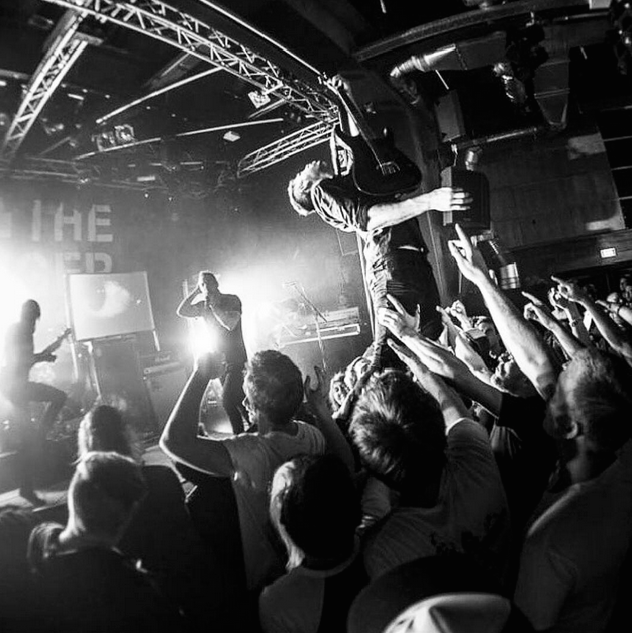
JR Ewing, august 2006 @ Magnet Club Berlin
Nothing to add.
i have been to a few crazy concerts but the craziest one would be when Kyuss got back together in 2010 at Hellfest.
i knew that Mondo Generator, Brant Bjork and John Garcia were playing in the same festival, in the same day and i remember talking to a few friends about how cool it would be if they got back together and played some tunes.
so… every band plays their set without mentioning or playing anything from Kyuss. the last band to get onstage in John Garcia and he plays some Kyuss songs for a while until he decides to talk to the crowd and mentions Kyuss.
He says that he saw Nick Olivieri and Brant Bjork playing before and that he would like to bring them onstage and play some Kyuss songs for the crowd. Before they got onstage, he mentions something like “… and Kyuss is back.” and they play Green Machine.
https://www.youtube.com/watch?v=FsD_AqABYIw
this is the shitty video i did from that song.
The craziest show I’ve ever been to was in a packed basement in the Beaumont Warehouse in West Philly with Stinking Lizaveta.
The Swell Season @ Admiralspalast. Not a big fan of this kind of music … but the audience was the craziest I ever saw / heard. The sang every song perfectly. All choir parts and most difficult parts. The whole room was like a professional choir. Nobody could believe this … the band nor the audience. It was like a rush ????
That’s my full name
It was christeene last sunday
Dwarves in Berlin ’05 were utter insanity.