My mother used to put stuff in boxes. Professionally. She did it for 30 years at the same small-sized suburban Italian company and while the boxes were sent everywhere in the world, my mom and her career weren’t exactly going places.
My dad, the only male among four siblings, had to drop out of middle school to help his father in the fields. Like many of his peers, he learned to think of work as something that is closely related to suffering, sacrifice and blind obedience.
Whenever I tell my parents about company breakfasts, team building events and gamification, they share a very specific look that I’ve come to interpret as “Our son is lying to us. He doesn’t have a job in Berlin. He’s squatting an abandoned building and carries stolen drugs across countries in order to pay for his groceries.”
I get that look. I do. Growing up with a blue-collar mindset made me both conscious of my current luck and weirdly aware of the seemingly absurd sides of the startup life.
This series of posts is the natural consequence of that.
CHAPTER 1: FINDING A JOB
 This is going to sound obvious, but in order to work at a startup – in Berlin or anywhere else – you need to either found one or be hired by one. I’m going to focus on the latter ’cause I’m a slacker and I’ve made it my life goal to achieve less and less every day.
If you’re smart you’ve probably created alerts that fire off an email every time a desirable position is available, either through Google Alerts or more specific job hunting platforms like Indeed.de or BerlinStartupJobs.com. What you might not know, though, is that when it comes to job titles startups can be as quirky as the side character of an indie TV series.
The chances that your alert will be triggered by the keyword “customer relationship manager” are thinner, for example, than the ones for the keyword “Customer Happiness Ninja”. Stop looking for “Sales Manager” and keep your eyes open for stuff like “Customer retention power ranger”, “Office management karate kid”, “Java Sorcerer” and any title that could have easily been invented by a Dungeon Master after his sixth pint of mead. ‘Cause nerdz.
Startups want their jobs to sound so cool that it’s impossible not to want them. I’m perfectly happy with my own job, but if I ever read an ad for a “fluffer of moral erections”, I’ll drop everything and go, even if it means I end up teaching old ladies how to dance salsa in a holiday resort a la Swayze in Dirty Dancing.
The exceptions to this rule are the internships. Companies don’t even try to make these “jobs” sound cool, given that the word “intern” is at times already an euphemism for “slave”.
Centuries ago, before the invention of coconut M&Ms or, like, minimum wage, I was doing an internship. Money was so tight that I felt compelled to rewrite the Wikipedia page for the term to reflect my true real feelings about the matter.
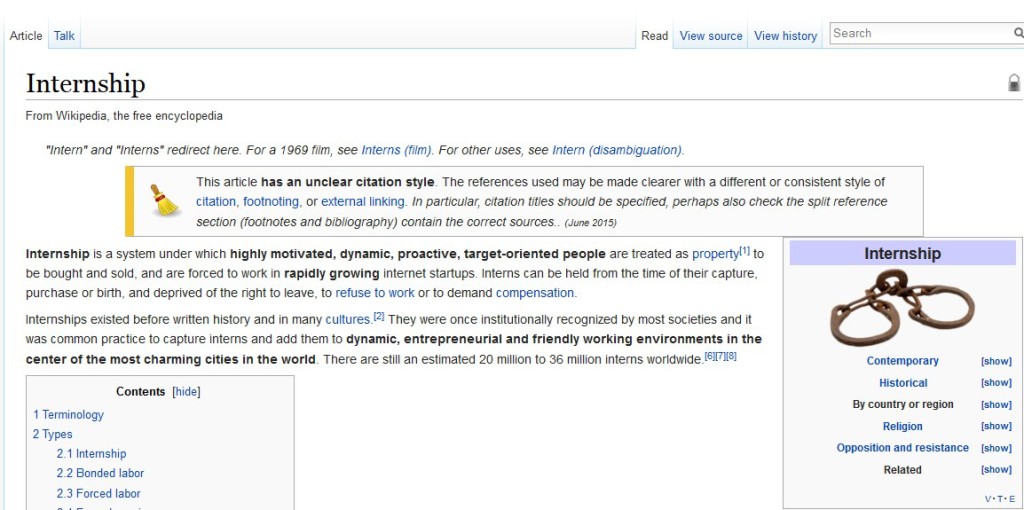
Unfortunately a Wikipedia editor told me I wasn’t being – air quote – objective about the facts. Fine, Mr. Logic. Whatever.
Anyway, you need to really read those job postings and check off the required skills one by one, even if that’s boring. And when you’re doing so, try to be honest with yourself about your real capabilities. I once thought my brain had no boundaries, but then it turns out that things like the Norwegian language or “Ruby on Rails” (I still think that’s the name of a synthetic drug) cannot be learned overnight.
Bummer.
Once you’ve found a position that seems perfect for you, don’t just start shooting off applications like crazy. You need to pick the right startup before even letting them pick you. Of course you wanna be employed by a winner and there’s one basic criteria to discern whether an internet company is gonna take over the world. Mark my words: It’s all in the name.
 Look around: the “General Motors” days are over. Don’t look for class, meaning or authority in a name. The startup world is now calling for “Goojdi”, “Faamp”, “Leerk” and “Huora” (which was gonna be the name of my own startup until someone told me it literally means “whore” in Finnish). In other words, you need to look for a name that sounds like something between the first words of a baby and what your cat may have written while walking on the keyboard.
The only acceptable alternative to this are Latin words. A lot of startup founders pick these, probably by listening to Harry Potter spells and noting down stuff that sounds nice. Sometimes it works, but other times your web agency ends up being called “ferocity” in Italian.
Roar.
In the next episode I’ll teach you how to actually apply for the startup job of your dreams.
Federico is an Italian in Berlin. He blogs, tweets, infiltrates the German language, and is currently employed at a cool internet company based in Berlin with a million open positions.
If you liked this, check out our observations on the Berlin startup scene, and get more practical advice about landing a startup job (with more GIFs!).






 Amanda
 Ulf (ex-EasyBib)
  Joc Cousteau
 Loll
Loll  Luke
Luke 

 v
v 
 cea
cea  Mike V.
  Dr Fun
  Frieda


 Yes
Yes 


 Ahsoka23


 James Glazebrook


 carnz
carnz 
 Muhamad Hammad
[…] gilt nicht nur für Deutschland, aber: Jungejunge, was für ein Medienhype geht da […]
Author lists 3 examples of Berlin startups that make global impact. One of those, 6Wunderkinder, returns a 404 on the index page.
Their site’s back up!
As someone who works in tech, but not a startup I look forward to the day where more people understand the distinction. And it’s possible to build a successful, independent and sustainable company in this field.
Genau.
Here is my article about the internships in Berlin:
https://avanthard.wordpress.com/2013/08/26/all-the-truth-about-internships/
My research shows that most of the startups are exploiting the young and talented, and I say “can’t pay, don’t hire! You’re not working for free, why should anyone?”. And everyone knows there are no instructors who’d teach you, you’re expected to work independently from the 1st day. The internships at startups unfortunately are NOT for the benefit of the intern, but vice versa and it’s against the law.
Creative sector is full of sins too, Transmediale and Berlinale survive totally thanks to un(der)paid interns.
Want to know the German law and your rights as an intern? Check this presentation: https://www.slideshare.net/JekaterinaPetrova/internship-culture-in-berlin-13nov
Thanks,
Katja
Thanks for sharing. We agree that the intern culture is a rotten one, especially here in Berlin. As someone who works in marketing/communications/community management, I hate to see my work devalued by ads for interns to do the work of juniors in this field. The example of the cleaner earning 3 x that of the marketing intern speaks volumes – should companies be allowed to pay insulting wages for roles, just because there’s a queue of people waiting to fill them? Should they only pay decent wages for jobs that no one else wants to do? Thanks for taking it upon yourself to champion this worthwhile cause – good luck with it!
Thanks for the comment, James.
It’s a dead circle here in Berlin; if they don’t sing the law about €8,50/h for all graduate-interns, young people (especially expats) will struggle just more and more.
InternsGoPro, a European organisation, came up with the idea to publish quality listings of the companies who offer internships, anyone who’s done one, can fill out a short questionnaire and rate the company. This would help at least future interns. https://internsgopro.com/rate-your-internships/
It is sad, absurd and totally wrong to be paid €300/m when you already have a BA or MA. You’ve invested money and time in your studies, while working part-time in a shop, and then you graduate and get paid 3 times less for all your hard work.
This a broken economy.
Amen, brother.
I my experience of almost two years in the environment I would say that, when you arrive, you will notice two kinds of dimensions: the “let me tell you about my startup/idea(r)” one and the one in which there is people who started a company. You don’t want to fall in the first one.
Thanks for the comment!
Do you mean some people just talk while others do? Or are you talking about the difference between startups and actual companies?
Oh, just seen your Facebook comment. You mean the latter.
That is an important distinction – between startups searching for a business case, and successful companies who have found theirs. Berlin needs more of the latter, but that doesn’t discount the work of the pioneers!