Author: Guest Blogger

  • Wedding: Workers, Foreigners and Beer

    Category:

    Photo by Linka A Odom

    Photo by Linka A Odom

    [EDIT: this competition is now closed. Click here to see if we’re running any open competitions]

    Letters from Berlin is a collection of 12 weekly essays, each focussed on a different district of the city. Bringing together photographers, filmmakers, writers, translators and theatre directors, Letters from Berlin (published by The Pigeonhole) reflects the many creative facets of this uncanny city, creating an album of vivid snapshots. 

    Enjoy an excerpt from one of our favourite essays, Marcel Krüger’s walk through Wedding, and enter our competition to win a free subscription to the series.

    Links, links, links, links,
    Ein Lump wer kapituliert.
    Links, links, links, link!
    Der rote Wedding marschiert!

    – Erich Weinert, 1929

    Wedding was a raw expanse of towerblocks, tattoo pits, kebab shops. Nogoodniks in mauve-coloured tracksuits decorated every corner. We had a properly respectful air as we passed through. This was how Berlin was supposed to be. […] The rearsides of the towerblocks loomed either side of a dirt pathway itchy with catkins beneath our sandals, and the word ‘proletariat’ rolled its glamorous syllables over my tongue.

    – Kevin Barry, from ‘Berlin Arkonaplatz – My Lesbian Summer’, 2012

    …Sometimes I think that while Berlin is the ever-changing Moloch on the plains of Brandenburg and the wetlands of the Spree, its outgrowth Wedding has remained endearingly static over the last fifty years. Maybe it always had a certain roguishness that prevented beautification and change. Wedding is allegedly always up-and-coming. ‘Der Wedding kommt’, Wedding is coming, some of my friends used to say when I visited Berlin for the first time in 2001, staying near the fleshpots of then ungentrified Prenzlauer Berg. Some keep repeating it to this day. Der Wedding kommt.

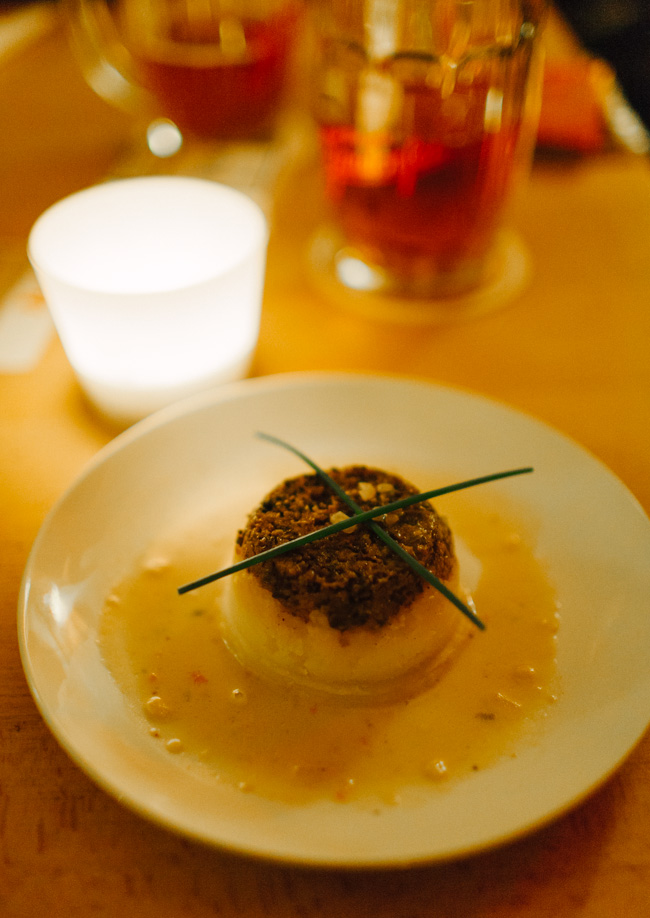
    It’s Sunday, by now after lunchtime and I’ve walked a bit: it’s definitely time for refreshments. I take a detour from Seestraße and step into a neighbourhood brewery, Vagabund Brauerei on Antwerpener Straße. Three American home brewers opened a small taproom here in 2013, and they serve their own craft brews together with classic German and Belgian beers.

    Like many other working-class areas, Wedding has a long tradition of brewing, which is slowly being rejuvenated. On nearby Müllerstraße is Eschenbräu, one of Berlin’s first craft breweries, open since 2001, and also close by is the best small beer speciality store in Berlin, Hopfen & Malz. There’s also the VLB Berlin (Versuch- u. Lehranstalt für Brauerei in Berlin), which provides research, training, education and service for the brewing industry. Founded in 1883, it moved to its current location on Seestraße in 1898, and until 1981 it even operated the Hochschul Brauerei, or brewery university, where students could try brewing different types of beer, which were then sold to the public.

    Vagabund Brewery has become a poster child for the local craft beer scene. It has been featured in articles in The New Yorker, Forbes travel, Der Spiegel and a plethora of German newspapers feting the craft-beer trend. One could easily say that Vagabund is a pub catering only to moustachioed expat drinkers and not to locals and is therefore a prime example of gentrification pushing out existing social structures, a topic hotly discussed in Berlin. As I enter the bright interior of the taproom, almost deserted so early on a Sunday afternoon, I’m glad to see both Matt Walthall and David Spengler, two of the three owners, manning the bar. We soon start chatting about beer and gentrification.

    ‘So often people ask us about this “trend” of locally brewed craft beer,’ Matt says. ‘David and I studied history, and that is part of what draws us to brewing: there’s so much history involved. In the eighteenth and nineteenth centuries, every Berlin neighbourhood had its own brewery – so, for us, the whole appeal is not about being trendsetters. We clearly see ourselves as part of a tradition.

    ‘We didn’t plan to come to Wedding specifically. We looked all over Berlin for a year and a half, but we couldn’t find the right combination of brew room, taproom and a big enough basement. I was actually the one who was the most sceptical of Wedding – I thought of Bernauer Straße, Plattenbauten and so on. And then I moved here and now I’m the biggest promoter. Wedding still has a strong community feel to it, and there are no areas here where whole blocks have been bought by developers, like in Neukölln. And it’s one of the few places in Berlin where the classic population structures have not been pushed out – the majority of our neighbours have been here for twenty or thirty years.’

    Indeed, the neighbouring commercial establishments are a strange mix of shisha bars, corner pubs with Sternenburger posters (‘Sterni’ is the cheap and mass-produced Berlin beer preferred by many inhabitants of Wedding) and bookmakers with bright neon signs reflecting off the street’s wet cobblestones. Three years ago, a man ran amok on the street here, armed with two knives and an axe, and was shot by the police. But in general nowadays, things are fairly quiet.

    ‘We love how laid back the street is,’ David chips in. ‘Sometimes when I’m in some of those “happening” districts down in the southeast of the city, I’m amazed because there’s just so many people. In our little promenade street, it’s much more laid-back and chill. I also like knowing the people from the neighbourhood and even having a drink with them sometimes. I think that might be harder to do somewhere else.’

    ‘In the beginning I was quite nervous about whether the neighbours would accept us,’ Matt admits. ‘There was this elderly woman walking past the shop every day when we were renovating, and she was always giving us this look, and I thought, “She probably hates us.” Then one day when I was outside cleaning the windows she came up to me and said, “Oh I’m so glad that you kids are here now!” Afterwards we learned that the previous tenants were Hell’s Angels.’

    I ask David how he feels about gentrification, especially in Wedding.

    ‘I guess some people would consider us gentrifiers,’ he says, ‘but really, that word just plain sucks, along with its negative connotations. We didn’t take over the entire block with the intention of knocking down all the old buildings, building new high-rise apartment complexes and charging three times the rent. That, to me, is “gentrification”. We just built a small brewery and bar in a place that once sold heroin out the back door. If a small, independently owned coffee shop or bookstore or chess store opens up, is that also gentrification? Where is the line, the gentrifi-demarcation? I made that last word up, by the way.”

    We both laugh, and I drain my glass. Time to walk more of Wedding. I finally hop on one of the trams and travel along Osloer Straße to the former border, clanking past the Currywurst booth on the corner of Prinzenallee, where sausages are served with the hottest sauces in Berlin; they have names like ‘Pain Is Good’, ‘Ground Zero’ and ‘Holy Shit’. We cross the Panke, the small, ancient river that runs all the way from Bernau in Brandenburg through Pankow and Wedding until it ends in the Berlin-Spandau shipping canal, another former border between East and West. I switch from tram to U-Bahn and emerge onto the corner of Brunnenstraße and Bernauer Straße soon after.

    After the Second World War, Wedding became part of the French sector of Berlin. French troops occupied a large military complex near Tegel airport and erected a cultural centre complete with a 15-metre-high faux Eiffel Tower on Müllerstraße. They protected the Western Sector, but the development of prospering Wedding still lay in the hands of the West Berlin city council.

    The buildings on the north side of Wedding’s Bernauer Straße and the street itself, including sidewalks, were in the Allied sector, while the buildings along the southern side were in Soviet territory. When the Berlin Wall was erected in August 1961, many of those who lived in these buildings frantically jumped from their windows before the buildings were evacuated and the windows bricked up. Wedding was also the western terminus of one of the first refugee tunnels dug underneath the Berlin Wall. The tunnel ran from the basement of an abandoned factory on Schönholzer Straße in the Soviet sector to another building in the West, passing underneath Bernauer Straße. Though well constructed and successfully kept a secret, the tunnel was plagued by water from leaking pipes and had to be shut down after only a few days of operation. Near the spot on Bernauer Straße where the tunnel ended, a section of the Wall has been reconstructed as one of the official memorials to the division of Germany.


    A few weeks before my walk, I was talking to Sven Goldmann, a journalist for the Berlin newspaper Der Tagesspiegel, who remembers growing up in Wedding during the Cold War: ‘My grandmother often reminded us how good we had it,’ he told me. ‘In the Thirties, Wedding had been a communist area and dangerous. People were shot here. Every third man was out of work and the women were sitting at home. Well, my grandmother was old. The younger generations had a better time: all the communists were living behind the Berlin wall, and there were no people out of work here. As kids we were happy: our parents worked at the Wittler bread factory in Maxstraße or at the Rotaprint printing press, and we played football on the many empty spaces among the buildings. Well, at least until the builders came and we had to find another pitch.’

    As Annett Gröschner writes in City Spaces: Filling in Berlin’s Gaps (Readux, 2015; trans. Katy Derbyshire), when the Wall was built, the neighbourhood around Brunnenstraße ‘lent itself to urban planning experiments. For the reconstruction of Wedding, soon revealed as its eradication, a gigantic money-wasting machine was set in motion, private land was bought up by non-commercial housing associations, old houses demolished and new ones built that looked thin-skinned and made only for sleeping in.’ Today, this is known as Brunnenviertel, a striking conglomeration of 1970s concrete and plastic.

    ‘One day our teacher took us to one of the watchtowers for tourists, from where we could observe East Berlin,’ Sven Goldman said, ‘and she told us how lucky we were to have all the new buildings here while the people in the East had to live in the shabby old houses.’

    After the Wall fell and capitalism had defeated communism, Wedding suffered. In a united Germany, Berlin companies no longer received state subventions, and many of the factories in Wedding closed as business was outsourced. In the last twenty-five years, unemployment in Wedding has been at a steady fifteen per cent, and even though there are initiatives by both state and city to tackle this, it seems many people here will remain without jobs for the foreseeable future. Petty crime is also widespread. Soldiner Straße near Gesundbrunnen, for example, had such a bad name that footballers at the 2006 World Cup described it as ‘Berlin’s Soweto’. Around the turn of the millennium, various groups were formed in an attempt to bring some positive energy to the area. The arts initiative Kolonie Wedding, founded in 2001, set up studios and galleries in what would be otherwise empty shop fronts and once a month hosts coordinated vernissage weekends with walking tours between the different venues.


    I take the U-Bahn and re-emerge from its depths on Nauener Platz, where the owner of the local kebab shop calls me ‘neighbour’ every time I stop by, and where a punk with beer on his breath once helped me out with washing powder at the laundrette. I reach my little apartment building again, the grey, two-storeyed one, nestled between the five-storey Wilheminian buildings to its left and right. The sun is finally out and the drunkard/madman gone, and on the other side of the street Turkish teenagers sit on benches in the park tilting their sunglassed faces skywards. As I enter the building, I find a poster hung there by Berlin police, informing me that someone has broken into our building while I have been out.


    This is Wedding: fifty-year-old corner pubs that once catered to off-shift workers and now serve those in need of a drink at ten in the morning; communists, resistance fighters and morphine addicts; a mini Eiffel Tower and young Americans reanimating the age-old brewing tradition of Prussian Berlin. It’s not a particularly nice place, but it is a prime example of the fascinating ruggedness often associated with Berlin that is fast disappearing from many other places throughout the city.

    HOW TO WIN A FREE SUBSCRIPTION FOR LETTERS FROM BERLIN –

    Just leave us a comment below. The first 10 comments get a free subscription!

    You have until 6pm on Friday 24th July to enter. Good luck!

    The Boring Bit (yawn, RULES):

    1. You must be 18 years or older to enter.
    2. ONE ENTRY PER PERSON!
    3. The first 10 comments win. Simple as.
    4. If you win, we’ll let you know by email how to claim your prize.

    10 Responses to “Wedding: Workers, Foreigners and Beer”

    1. Rose says:

      I definitely need to spend more time in Wedding, despite living right on the other side of Berlin!

    2. pszimokus says:

      This makes me want to go back to Berlin to explore the city further.

    3. laura lee says:

      I love wedding ,special people x

    4. Marie says:

      I’m so looking forward to moving to Berlin’s Soweto in just about half a month! (:

    5. Ruth Barber says:

      Superb. I will also write an essay for you if you are looking for contributions.

    6. Susanne says:

      love it! :)

    7. Jen says:

      If I (n)ever get married, I’ll do it in Wedding.

    8. Hannah Graves says:

      This is wonderfully written and actually makes me want to go to Wedding!!

    9. Carlos says:

      Hey! :) I would be happy to wind a free subscription!

    10. paghno says:

      Zurückbleiben bitte..

    leave a comment

  • How to work at a startup: 1. Finding a job

    Category:

    By Federico Prandi.

    My mother used to put stuff in boxes. Professionally. She did it for 30 years at the same small-sized suburban Italian company and while the boxes were sent everywhere in the world, my mom and her career weren’t exactly going places.

    My dad, the only male among four siblings, had to drop out of middle school to help his father in the fields. Like many of his peers, he learned to think of work as something that is closely related to suffering, sacrifice and blind obedience.

    Whenever I tell my parents about company breakfasts, team building events and gamification, they share a very specific look that I’ve come to interpret as “Our son is lying to us. He doesn’t have a job in Berlin. He’s squatting an abandoned building and carries stolen drugs across countries in order to pay for his groceries.”

    I get that look. I do. Growing up with a blue-collar mindset made me both conscious of my current luck and weirdly aware of the seemingly absurd sides of the startup life.

    This series of posts is the natural consequence of that.

    CHAPTER 1: FINDING A JOB

    This is going to sound obvious, but in order to work at a startup – in Berlin or anywhere else – you need to either found one or be hired by one. I’m going to focus on the latter ’cause I’m a slacker and I’ve made it my life goal to achieve less and less every day.
    If you’re smart you’ve probably created alerts that fire off an email every time a desirable position is available, either through Google Alerts or more specific job hunting platforms like Indeed.de or BerlinStartupJobs.com. What you might not know, though, is that when it comes to job titles startups can be as quirky as the side character of an indie TV series.

    The chances that your alert will be triggered by the keyword “customer relationship manager” are thinner, for example, than the ones for the keyword “Customer Happiness Ninja”. Stop looking for “Sales Manager” and keep your eyes open for stuff like “Customer retention power ranger”, “Office management karate kid”, “Java Sorcerer” and any title that could have easily been invented by a Dungeon Master after his sixth pint of mead. ‘Cause nerdz.

    Startups want their jobs to sound so cool that it’s impossible not to want them. I’m perfectly happy with my own job, but if I ever read an ad for a “fluffer of moral erections”, I’ll drop everything and go, even if it means I end up teaching old ladies how to dance salsa in a holiday resort a la Swayze in Dirty Dancing.

    The exceptions to this rule are the internships. Companies don’t even try to make these “jobs” sound cool, given that the word “intern” is at times already an euphemism for “slave”.

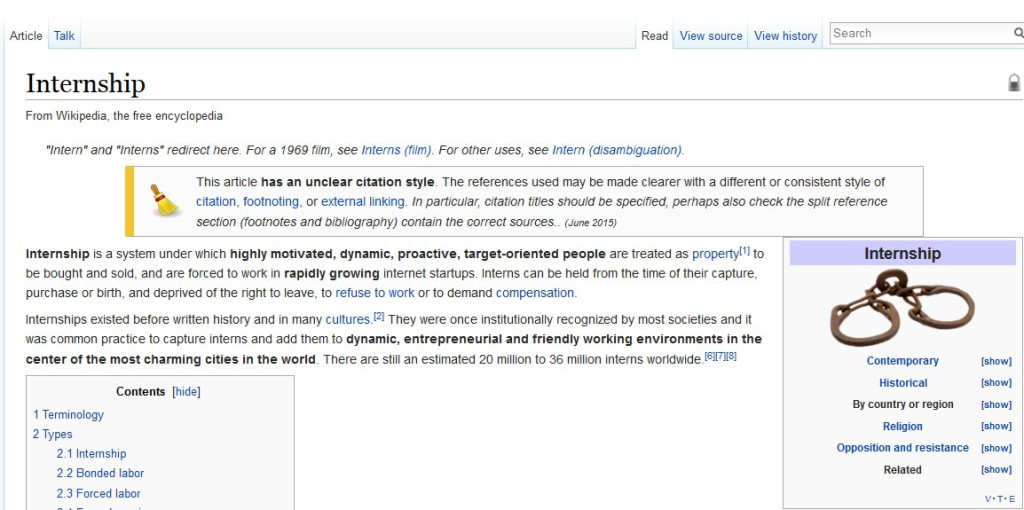
    Centuries ago, before the invention of coconut M&Ms or, like, minimum wage, I was doing an internship. Money was so tight that I felt compelled to rewrite the Wikipedia page for the term to reflect my true real feelings about the matter.

    internship_wiki

    Unfortunately a Wikipedia editor told me I wasn’t being – air quote – objective about the facts. Fine, Mr. Logic. Whatever.

    Anyway, you need to really read those job postings and check off the required skills one by one, even if that’s boring. And when you’re doing so, try to be honest with yourself about your real capabilities. I once thought my brain had no boundaries, but then it turns out that things like the Norwegian language or “Ruby on Rails” (I still think that’s the name of a synthetic drug) cannot be learned overnight.

    Bummer.

    Once you’ve found a position that seems perfect for you, don’t just start shooting off applications like crazy. You need to pick the right startup before even letting them pick you. Of course you wanna be employed by a winner and there’s one basic criteria to discern whether an internet company is gonna take over the world. Mark my words: It’s all in the name.

    Look around: the “General Motors” days are over. Don’t look for class, meaning or authority in a name. The startup world is now calling for “Goojdi”, “Faamp”, “Leerk” and “Huora” (which was gonna be the name of my own startup until someone told me it literally means “whore” in Finnish). In other words, you need to look for a name that sounds like something between the first words of a baby and what your cat may have written while walking on the keyboard.

    The only acceptable alternative to this are Latin words. A lot of startup founders pick these, probably by listening to Harry Potter spells and noting down stuff that sounds nice. Sometimes it works, but other times your web agency ends up being called “ferocity” in Italian.

    Roar.

    In the next episode I’ll teach you how to actually apply for the startup job of your dreams.

    Federico is an Italian in Berlin. He blogs, tweets, infiltrates the German language, and is currently employed at a cool internet company based in Berlin with a million open positions.

    If you liked this, check out our observations on the Berlin startup scene, and get more practical advice about landing a startup job (with more GIFs!).

  • Portrait: Mike Shannon, Cynosure Recordings

    Category: ,

    Mike Shannon Berlin rooftop

    by Emma Robertson

    Mike Shannon hates interviews. A DJ, producer and label boss for over 15 years, Mike is the kind of artist that prefers to let the music do the talking. When I ask him about it over coffee at his flat in Kreuzberg, he laughs. “Sometimes when art is over-conceptualised,” he says, “It takes away from the actual art itself.” Luckily for us, his music speaks volumes on its own.

    It’s not that Mike is shy — in a city like Berlin where everything is in excess, there’s no room for timidity. Mike chooses to stand out in a different way. His particular brand of music doesn’t jump on trends or ride the bandwagon. A pioneer in the Canadian techno scene, his career has seen a steady upwards trajectory over the years and much of that has to do with the authenticity of his music: “For me, what I’ve been doing… I haven’t really moved around. I’ve stuck with it, and in a city like this, people appreciate that. Even if it doesn’t make you stand out, it earns you a different kind of recognition: respect.” It’s for that reason that when people write about Mike Shannon, they call him a DJ’s DJ. His technique, creativity, and understanding of music are very special. The art of performance is something he will never compromise.

    Mike Shannon Berlin studio

    As a DJ and a live act, you must experience a lot of pressure in your life: creatively, on stage, in the studio, in the office… What’s your favourite kind of pressure?

    Favourite pressure? I don’t know if I like pressure at all! (Laughs) My favourite would have to be the way we’ve been doing things lately with my live act with David DeWalta! We only know more or less half of what we’re gonna do… Maybe less! The other half is wide open territory! There is a certain amount of pressure when you’re improvising like that that creates the best possible situations. When you’re in unknown territory, it’s amazing what can happen.

    At the same time, though, you’ve talked previously about your move to Berlin lending you a sense of calm, particularly when you’re DJing.

    Sure. That’s an example of a pressure that I’ve felt very relieved from playing in Berlin. There’s a big difference to the way things are here, as far as DJing is concerned. You play six, seven, eight hour sets. You pace things very differently. You take your time. There’s a different school here for that sort of thing. You play a whole lot differently than you would in an hour-long timeslot, for example.

    Does that sort of energy affect you?

    Totally. When you’re playing an hour-long DJ set, you have to get to the same point in a fraction of the time. There’s less time to tell the same story. I always prefer the sessions where you have time to build up to those explosive moments.

    Is it difficult to maintain an element of surprise with your sets?

    Digital culture has kind of exploded, so it’s definitely hard to pull out tracks that no one’s heard before. People are just generally way more aware of things than ever before. It’s easier to get access, which is kind of cool but it also means that the only way I truly surprise anyone these days is when I play my own things that no one’s heard before.

    We talked about improvising earlier… Does that play into your DJ sets as well?

    Yeah! I think there are certain combinations of records that I always somehow go back to putting together. They’re two things that fit together like a glove so it’s hard to separate them, but otherwise, even my DJ sets are pretty much entirely improvised.

    I know you love to just get the gear on stage and see how things go on the fly, particularly with the live act with DeWalta that you mentioned earlier.

    It’s funny, once we were playing at this Arma17 event in Moscow and we were on after this really amazing experimental jazz band. We changed the plan last minute and just did half an hour of ambient stuff and we had this really long droney intro. The transition that happened there was really amazing. We did it all on the fly, right then and there. It’s funny how those things just work out sometimes.

    Mike Shannon Kreuzberg studio

    Born and raised in the suburbs of Ontario, Canada, Mike’s career has taken him everywhere from Montreal to Santiago. He fell under Berlin’s spell in the mid 2000s: he’s happily made a home here with his wife and seven-year-old daughter, and likewise carved out a niche for the distinct type of techno that he creates, collects, and shares through his labels Cynosure Recordings and Haunt Music. He hasn’t forgotten his roots, though. His days in Kitchener-Waterloo throwing parties, booking his idols from across the river in Detroit, and cultivating a music community with like-minded friends has done a lot to propel him to where he’s at now.

    The view from Mike Shannon's flat

    Do you feel at home here in Berlin?

    I couldn’t imagine being anywhere else really. I’ve planted a lot of roots here. I can’t imagine having the same kind of quality, even in Canadian cities like Toronto or Montreal. There’s no way I would have the culmination that I have here anywhere else.

    Why not?

    It was always a struggle for me to make a living as an artist in Canada. The sound that I was playing, that wasn’t really happening enough to sustain myself the way that I can here. In terms of success, of course it depends on how you gauge those things. But it’s funny, the grass is always greener on the other side, you know? You become a bigger artist in Canada when you’re away from it. People get excited about something that’s from somewhere else. You’re never famous where you’re from! (Laughs)

    Do you think that your hometown, Kitchener, Ontario, had any influence on you, creatively or musically?

    It’s a small town, so there were many moments where you had a lot of time on your hands! We built the scene there. We really built that ourselves! We had our headquarters downtown in a record shop… It was a meeting point for so many people. It became a community. And that was something that really influenced us. You realise how important it is all these years later, to have that kind of community around.

    Can you tell me about the parties you used to throw back then?

    We threw all kinds of parties, from warehouse events to art scene kind of nights. We were very lucky in terms of where we were geographically, we had connections with those artists that were just south of our border in Detroit, and they weren’t huge artists at the time either: Theo Parrish, Mike Huckabee, D-Wynn, Boo Williams, Robert Hood… Those guys would drive up sometimes, you know what I mean? I remember a party way back when Dan Bell played and he was cool with, like, a case of beer basically! (Laughs)

    Wow. Times have changed!

    Way different times. Those were the days! We were able to bring in high-calibre people. That’s what made it special, too, just having those deep connections and having those DJs come up and play what they wanted to play. We just kept plugging in the things that we loved and our heroes that we wanted to have play there. Every time we had the opportunity to take advantage of that, we would.

    Mike Shannon modular synth

    Like most music producers, Mike is a nerd at heart. His studio space recently relocated to a small room in his home in Kreuzberg, and when he brings me downstairs for the grand tour, his face lights up. He can barely keep his hands off the gear: even when he’s talking to me, he’s tinkering around on his self-built modular system or on his laptop.

    MIke Shannon modular synth

    Tell me about your studio set-up. What’s going on here?

    Sure, yeah! Everything is based around my computer. I do a lot of sequencing and sound design with computer editing. Next to it, I’ve got this modular system that I’ve been building for years. I add a little bit to it over time, and recently I’ve gotten into building some of those elements from scratch, which is really interesting. I’m getting even deeper into the nerd thing! (Laughs) More than ever before!

    Is this where you feel most at home?

    Probably! I love being in the studio. For me, when things are getting stressful, or when things are getting to be too much, I disappear in there. It’s the best way to relieve some of my daily stresses. It’s my escape. For the moments that I’m in there, it’s an escape.

    Mike Shannon studio nerd

    You just moved your studio back here, right? How important is it to have this space in your home?

    It’s been a big change for me. There’s certain moments where you have an idea and you can bounce on it right away! Whereas before, the time it would take me to go down the street to the studio, I’d lose the momentum or get completely distracted… It’s perfect to have this ability to wake up in the middle of the night and work on something right away if I want to. It’s easier to act on creativity in this environment.

    In another interview of yours from years ago, you said that, “My goal is to make a track that won’t be forgotten after one play, a record that you could put on years from now and still get the same feeling.” Do you think your productions so far have accomplished that?

    Not everything has been timeless, no. There are certain things that I slightly regret that definitely sound like they’re from a very specific time. I think if you can put a date on it, then it’s not timeless. It’s not so easy! But I do think I’ve made some tracks that are timeless. I hope there’s one at least!

    Space Hall records close up

    Mike is a vinylphile. His record collection spans multiple walls in his office, and it’s not uncommon to leave his place with a stack of CDs or records that he just has to have you listen to. He grew up in a musical household — a tradition that he carries on in his own home. There’s always some kind of melody floating around, whether it’s a Bohren & der Club of Gore track, a tune he’s working on with his daughter, or the latest release from his label. Ever since buying his first record (Rob Base and DJ EZ Rock’s “It Takes Two”) when he was young, Mike was hooked on vinyl. He’s become a regular at Space Hall in Kreuzberg, so he takes us on a quick tour of his favourite sections. Flipping through the house and techno crates, he’s completely in his own world.

    Mike Shannon Space Hall records Kreuzberg Berlin

    I read that you used to listen to Thomas Dolby’s The Golden Age of Wireless. You said something funny, which was that it was “a record that would fuel your little world.”

    It really was! I still have that record in my office! (Laughs) I still listen to it. I put on “Windpower” and it changes everything! I’m moving in the office when I put that on!

    Is there a record that kind of accomplishes the same thing for you today?

    I think probably the coolest record that that I listen to endlessly is The Hearts of Empty from these guys called Dakota Suite. It’s on a label called Karaoke Kalk, which is by far my favourite German label. I’m rarely disappointed with the records they put out.

    Let’s talk about Space Hall for a bit —

    This is my favourite record store in the world! I buy all kinds of different records here — you can buy just about any genre here. That’s the best thing about this place is that they have a massive backstock that really expands all the way through every genre. Their techno and house section is particularly good, which is what I like to buy mostly. The guys that work here are crazy as hell! It’s a very relaxed atmosphere.

    Mike Shannon Space Hall records

    It’s my first time here and I feel very welcomed. I’m always secretly a bit intimidated coming into record shops for some reason.

    I’ve totally been there. People get really scared! Some people get really intimidated in record stores, especially these famous shops; you walk in and your tension goes up and you’re scared to talk to anybody. There are definitely certain shops in Berlin that are like that but at Space Hall, it’s way more relaxed. I can light up a smoke in the shop and be completely at ease with what I’m doing there. I can almost always find what I want to find, too.

    When you’re shopping, where do you start? Do you know what you’re looking for?

    No, no, no. I almost never know exactly what I’m looking for in there. I start by looking at everything that’s new in house and techno, I look through and listen to all of them. I skip through and I like to shop maybe twice or three times a week. I start there in the morning and go through as much as I can. I could spend days at Space Hall and not get bored.

    Cynosure records Space Hall

    There’s definitely a certain romance about wax. Those who love it really love it.

    There’s something about flipping through records in my bag or at the shop, something about that whole process that I find way more comfortable than scanning through CDs or files. I try to do that! I’ve had a couple of situations where my records didn’t come and I had to try to play with just burning some CDs… I couldn’t do it well at all. Totally lost on how I organise myself. With vinyl, you’re touching it and feeling it. There’s something really special about that.

    Mike Shannon Space Hall records Berlin

  • Brewberlin: The Big Berlin Beer Week Roundup

    Category: ,

    By Hannah Graves.

    Craft beer is officially A Thing. It’s not going anywhere, so it might be time to embrace it. The people behind Berlin Beer Week insist that they aren’t hipsters intent on ruining booze for everyone, but instead want people to try something other than watery yellow piss beer – maybe something with actual flavour.

    They want us to appreciate beer in Berlin, the same way we’ve come to appreciate burgers. Who eats at McDonald’s when they know they can go to The Bird? There are some seriously strong Berlin breweries and bars that do what they do exceptionally well. So, whether you’re a seasoned beer geek or someone just venturing into the world of craft beers, this week should be a good one.

    The Berlin Beer Week website has a full run down of this “celebration of beer culture”, starting tomorrow! And here’s my pick of the eventsI’ll be attending over the week. Prost!

    The Opening Party

    I’ve been behind the scenes at a brewery before, so will be taking the chance to snoop around Brauerei Lemke, where 10 Berlin brewers will be pouring their beers. This isn’t one of the free events but the very reasonable ticket price does get you the Berlin Beer Week glass and two small beers. Beer bonus!

    Das Gift

    It’s possible that you MIGHT be a wee bit tipsy after that opening party, and while there will be food trucks at the Brauerei, I’d recommend getting to Das Gift. This Neukölln favourite is going to be serving up its famously good Scottish food next to Scottish ales. Some dishes have been paired with matching beers, and I’ll be having the haggis!

    Das Gift Scottish Food

    John Muir

    Sunday has long been my favourite day of the Berlin week, and I am more than happy to spend it eating barbeque. The bar with the speakeasy vibes is teaming up with Spice Spice Baby and the Berlin beer team on a bike, Flying Turtle, for some seriously summery vibes.

    Monterey Bar

    I’m going to be drunkenly throwing the horns after trying the Slayer beer at Monterey, where they will be celebrating creative design and rock music in beer culture. Three local artists from Berlin’s street art scene will be creating original mockup labels live, accompanied by a rock and metal DJ set.

    Monterey Bar Berlin

    Das Gift (AGAIN!)

    This one was an easy decision to make. Cake. Beer. Beer cake. “A sculpture of cupcakes all made with craft ales as ingredients”. SOLD.

    The Closing Party

    Apparently, Stone Brewing are a big deal, the people behind beers with names like “Arrogant Bastard”. Being cool, they want to have their bit of Berlin too, so this event will be held at the site of their future new brewery and restaurant. There is a mind-blowing list of beers on offer, as well as non-alcoholic drinks, food and music. Also, 100% of proceeds from the event will go to a local charity organisation, so you’ll be drinking beer for a good cause.

    —

    Good luck making it through seven days dedicated to beer. I’m going to give it my best shot ???? There’s SO MUCH going on, and for those who aren’t allergic to physical activity, there is even climbing with craft beer (?), and walking tours and bike rides. Even if you just try a craft beer at some point this week, Berlin Beer Week will have been a big success.

  • Berlintercourse: My first sex party

    Category:

    You all know by now that my quest for new experiences knows no bounds, so you’ll probably only be half surprised to learn that I recently attended my very first sex party.

    It all started during one of my Sundays spent dancing the day away at Berghain. I met a fairly good-looking guy, and our conversation turned quickly and naturally towards sex. Before I knew it we were comparing our number of Tinder matches and sexual partners. I mentioned this upscale sex party I’d heard of, and my new companion told me about a secret one happening regularly in Berlin. He suggested we go together and, without hesitation, I said I’d love to.

    Fast-forward a few weeks, and this guy is telling me that he’s arranged for us to attend the next edition of this secret sex party. But as this is Germany, I still had to submit an official application full of disappointingly pedestrian getting-to-know-you type questions, and include a photo of myself. I nervously waited for a reply, and felt like I had won the lottery when I finally received an email welcoming me to this very special club.

    It was a fancy dress party, so I spent a few days carefully planning my perfect outfit. I tried to look my ultimate sexy self, in my most slimming high-waisted thong and a transparent mesh crop top. But when I entered the venue, I found that most people seemed more interested in looking fun and artsy than hot. Just as I was wondering, “how come everyone is wearing more clothes than I am?” a girl walked past wearing nothing but a pearl thong, immediately making me feel better about my revealing outfit.

    We grabbed our first drinks and scanned the main room, a vast space that nonetheless fostered an intimate atmosphere. I remember anticipating the moment that it would start being all about sex. Was there going to be some kind of signal? Right now, it looked like a large group of old friends catching up and having a regular night out.

    Well, except for the guy proudly displaying a drill with a dildo attached to it. He was a non-threatening old bear, but I couldn’t help feeling a little violated when we pointed that thing at me. I sought refuge in the smoking area, always a good place to meet new people. Little did I know I was about to make my first almost faux pas.

    I had brought fortune cookies to share and decided to hand them out to the smokers sat next to me on a worn-out couch. After everyone had read out loud what was written on their strip of paper, someone asked, “So, what did you get?”

    “Mine says ‘You will have good health’, which I’m happy to hear considering my flatmate just told me that he has chlamydia!” Everyone went silent for a minute, and that’s when I recognised that this might not be the best place to joke about STDs. Then everyone started laughing, and I realised that I might have stumbled on the perfect ice-breaker. Phew!

    After a few more drinks, I was approached by a young man who told me: “The first thing I noticed upon entering the room is your butt.” Given what I was wearing, this came as no surprise. He offered me wine and told me he wanted me to meet somebody, before walking off towards a girl who was chatting with somebody else.

    He interrupted her to point at me and whisper something into her ear. Then they both walked my way and stood around me. She was his girlfriend and they attended this party with the sole purpose of finding girls to have threesomes with. I actually even got to meet the girl they had hooked up with at a previous party, which I guess was weird – but it takes a lot more than that to make me feel uncomfortable these days.

    We flirted for a little while before they made it clear it was time to go to the other room – the darker one filled with mattresses placed on top of piles of euro-pallets. I couldn’t believe I was actually going to have my first threesome, after several missed opportunities, and I had no idea what to expect. Was it going to be awkward? Were they going to get busy with each other while leaving me out? How was my second time with a girl going to be? I had no idea, but we got undressed after making out for a little while. What happened next ended up being one of my best sexual experiences so far.

    There I was, lying on my back, while a hot guy and a hot girl were making sure I had the time of my life. I never felt left out and I’m pretty sure neither of them did either. And the other people getting busy on the nearby beds hardly even registered with us. A very natural synergy arose and I kept on thinking, “I can’t believe this is finally was happening.”

    Once we were done, we got dressed and I retrieved my shoes from a tangle of arms and legs on the opposite side of the room. I had one more drink with the couple and decided to finally hit the dance floor. The DJ had started playing ridiculous pop songs and the party was approaching its end. Unlike the “regular” music-oriented parties that Berlin is known for, this one was indeed set to finish promptly at 4 am.

    I spent the rest of the night talking to other guests, save for a single detour back into the second room on the invitation of a friend. I was seriously impressed with how uncomplicated and easy-going the vibe was. It felt like a hippie, free love-inspired gathering – think more Burning Man than the Shortbus sex club scene.

    I never would have predicted that this night would meet – let alone exceed – my expectations. After reading about Slutever and Chelsea Summer’s experiences, I wasn’t sure I’d do anything sexual even if I found myself in a similar situation. But I guess that after all this time I shouldn’t have been surprised to find out that, out of all the cities in the world, Berlin is the perfect place for these kind of liberal, experimental, mutually rewarding parties.